

Research from the ADP Research Institute shows that many Australians live paycheque to paycheque. It’s a common situation, and it highlights how important it is to stay on top of personal finances.
Finding time for a financial review can be hard when work, family commitments and daily tasks compete for attention. Yet an organised review is one of the most effective ways to improve long-term financial stability. It works much like an annual health check, helping you identify small issues early and assess progress across spending, savings and debt.
A structured approach keeps the process manageable and gives you a clearer picture of your overall position.
Key Takeaways
What a Personal Financial Audit Covers
A personal financial audit reviews all areas that influence your financial position, including income, expenses, savings, investments, debts and current goals. The aim is to create an updated and accurate view of where you stand.
Gather Documents
Collect bank and credit card statements, superannuation details, investment reports, loan statements and insurance policies.
Review Cash Flow
Assess the movement of income and expenses over the past year. This helps you see where money is being allocated and whether adjustments are needed.
Calculate Net Worth
List all assets and liabilities to understand your current financial position and how it is changing over time.
Check Goal Progress
Review the goals you set for the last year. Look at improvements in savings, reductions in debt and any milestones reached.
Why an Annual Review Matters in 2025
Economic conditions continue to shift. Interest rates, inflation and tax thresholds change over time, so strategies may need to adjust as well.
In 2025, cost-of-living pressures and market fluctuations will remain key factors for many households. Data from the Australian Bureau of Statistics shows that changes in residential property values are influencing household wealth, while savings patterns vary across age groups and income brackets.
An annual review allows you to reassess your structures, manage tax considerations, update investment allocations and check whether your debt arrangements are still suitable.
End-of-Year Checklist: Super & Tax Considerations
General Advice Warning: The following information is general in nature and does not consider your personal circumstances.
Steps taken before 30 June may influence your overall tax position and future savings outcomes.
1. Review Superannuation Contributions
Superannuation remains an important long-term wealth-building tool.
Tip: Review your contribution levels through myGov and consider whether salary sacrifice arrangements still suit your goals.
2. Non-Concessional Contributions
Using after-tax income to grow super can be effective depending on your stage of life and retirement plans.
Investment earnings inside super are generally taxed at up to 15%, which may be lower than an individual’s marginal rate.
3. Spouse and Co-Contributions
Budgeting in 2025: Review Spending and Build a Plan
Budgeting is about allocating income with intention. It helps align spending with your priorities and ensures that essential items and future savings are accounted for.
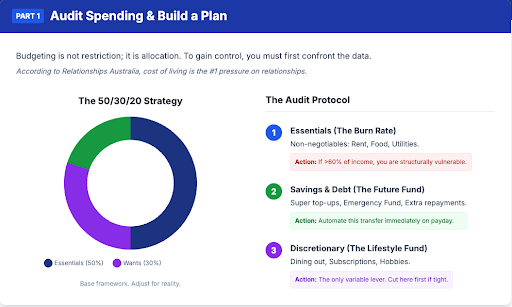
The Audit Method
Start by collecting at least three months of transaction history from all bank accounts. Categorise each item into one of the following groups.
Essentials (The Burn Rate)
These are core expenses required to maintain day-to-day living.
Examples: rent or mortgage payments, groceries, utilities, insurance, minimum debt repayments and transport.
Review point: If these expenses take more than 50–60% of take-home pay, it may indicate financial strain.
Savings and Debt Strategy (The Future Fund)
This category supports your long-term financial position.
Examples: extra super contributions, emergency fund deposits, investment contributions and payments above loan minimums.
Tip: Automate these payments on payday. Many households target around 20% of net income for this category.
Discretionary (The Lifestyle Fund)
These are optional expenses.
Examples: dining out, subscriptions, hobbies, holidays and non-essential shopping.
Adjustment point: If financial pressure increases, this is typically the most flexible area to reduce.
Research from Relationships Australia notes that rising living costs place pressure on many households, showing how a clear budget can support both financial and personal wellbeing.
The 50/30/20 Framework
Use this as a starting point:
Adjust it to match your circumstances.
Debt Audit and Repayment Strategies
Debt can limit financial flexibility, but a structured review can help you regain control.
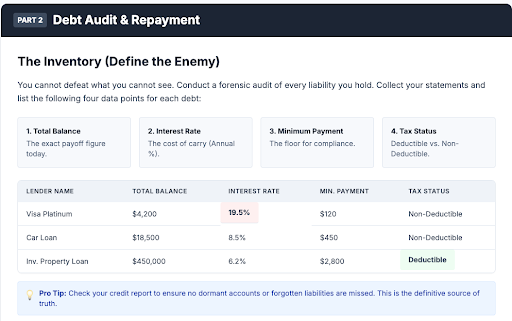
Step 1: List All Debts
Create a table including:
Step 2: Choose a Repayment Strategy
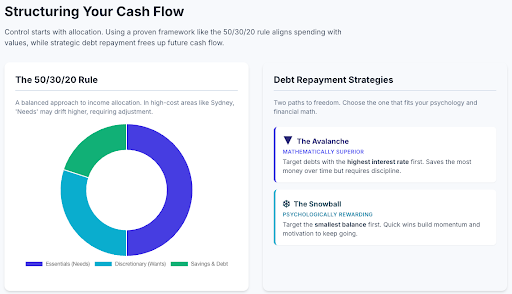
Avalanche Method
Pay all minimums, then direct surplus funds to the highest-interest debt first. This approach aims to reduce total interest payable over time.
Snowball Method
Pay all minimums, then direct surplus funds to the smallest balance first. This approach can provide quicker milestones to maintain motivation.
Home Loan vs Investment Loan
Many households focus on reducing non-deductible debt first to strengthen long-term financial outcomes.
Investment Maintenance and Tax Planning
Market changes may shift your portfolio away from its intended allocation.
Rebalancing
If your target allocation is 60% growth and 40% defensive assets but market movement changes the ratio, adjustments may be needed. Rebalancing inside super is often tax-effective.
Tax-Loss Harvesting
For investments held outside super, selling assets at a loss can offset capital gains. This must be managed carefully to comply with ATO wash-sale rules. Professional advice is recommended.
Prepaying Expenses
Property investors or business owners may choose to prepay certain deductible expenses before 30 June to bring forward a tax deduction for the current year.
Insurance and Estate Planning
Managing risk is an important part of long-term financial planning. Recent findings from Monash University show that financial uncertainty affects a large number of young Australians, highlighting the value of preparation.
Insurance Review
Estate Documents
Next Steps
A financial review provides clarity and structure. You don’t need to complete every step at once — even small adjustments can help improve long-term outcomes.
If you want support turning this review into a clear plan, Navigate Financial Wealth can assist.
Speak with Navigate Financial’s Licensed Adviser
A financial review can raise questions about superannuation, contributions, debt structure or future planning. If you’d like personalised guidance, you can arrange a conversation with a licensed adviser at Navigate Financial. Our team can help you understand your options and outline practical steps for the year ahead.
FAQ
How often should I conduct a financial review?
Many people review their finances annually. However, events such as marriage, the birth of a child or receiving an inheritance may require a more immediate review.
What is the difference between deductible and non-deductible debt?
Deductible debt is borrowed for income-producing purposes, and interest may be tax-deductible. Non-deductible debt is used for personal purposes and does not offer any tax deduction.
Should I pay off my mortgage or invest?
This depends on your goals, risk tolerance and tax position. Paying off a mortgage offers a return equal to the interest saved, while investing introduces investment risk and the possibility of higher long-term returns.
What happens if I exceed super contribution caps?
Excess contributions may be taxed at your marginal tax rate, along with an interest charge. It’s important to track your concessional and non-concessional contributions throughout the year.
When should I engage a financial adviser?
Engage an adviser when your financial situation becomes more complex — for example, when managing investments, planning for retirement, owning a business or coordinating tax strategies.
General Advice Warning: The information in this article is general in nature and does not take into account your objectives, financial situation or needs. You should consider whether the information is appropriate for your circumstances and seek advice from a licensed financial adviser before acting.